
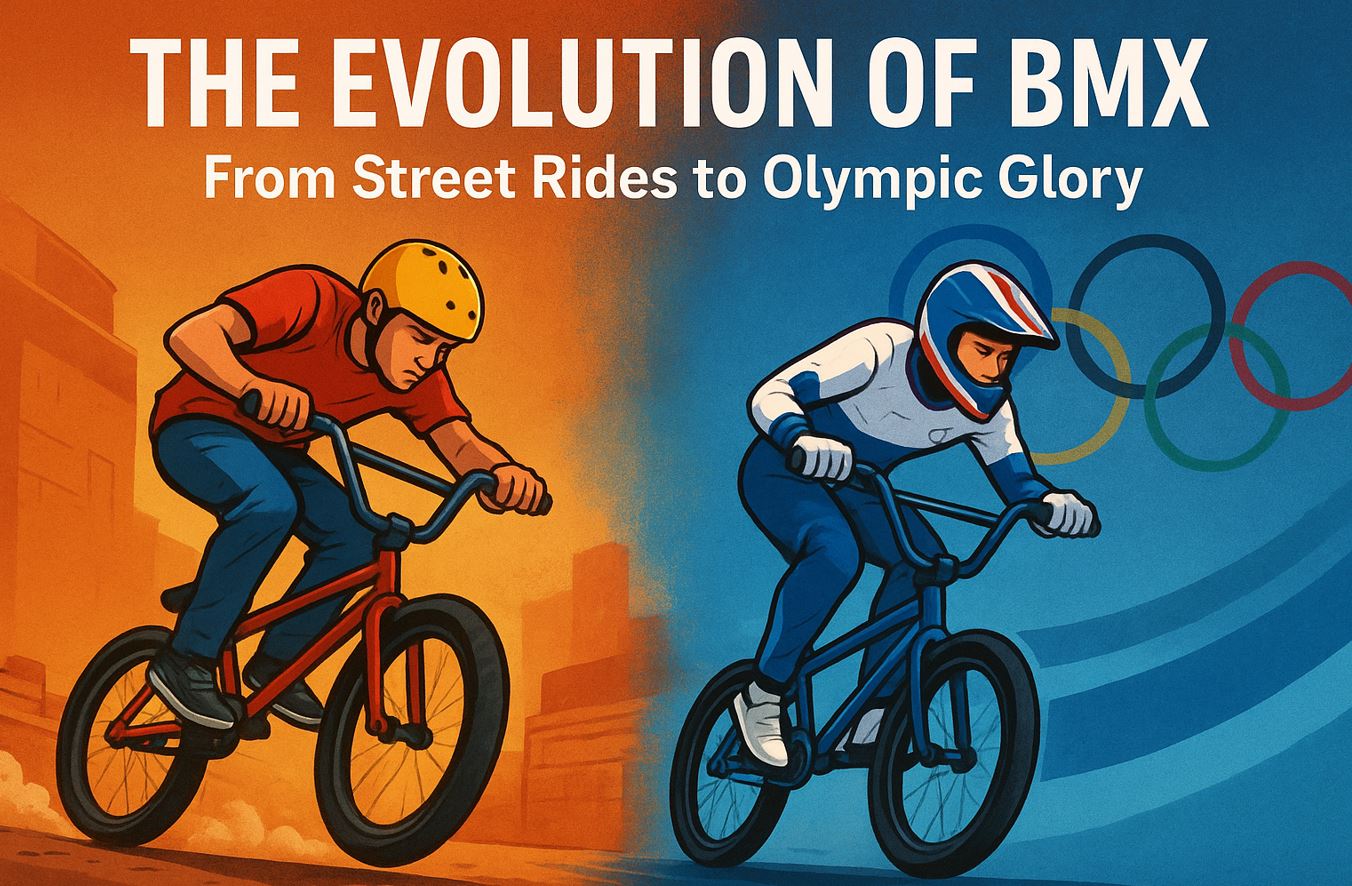
BMX — short for Bicycle Motocross — has grown from a small underground movement in California’s dusty neighborhoods into a global sport celebrated on the world’s biggest stage: the Olympics. What started as a pastime for kids imitating motocross riders has evolved into a highly skilled, competitive, and culturally rich discipline that blends creativity, adrenaline, and freedom.
The story of BMX is not just about bikes and tricks — it’s about passion, community, and the relentless drive to push boundaries.
The Birth of BMX: California in the 1970s
The roots of BMX trace back to Southern California in the early 1970s. During this era, motocross racing was exploding in popularity, with legends like Roger DeCoster inspiring young fans across the U.S. Many kids, who couldn’t afford or weren’t old enough to ride motorbikes, began using their bicycles to mimic motocross moves on dirt tracks and vacant lots.
These improvised dirt trails became the first unofficial BMX tracks. Riders began modifying their bikes with knobby tires, stronger frames, and reinforced handlebars to handle the jumps, bumps, and rugged terrain.
In 1972, On Any Sunday — a film featuring motocross racing — played a pivotal role in popularizing this emerging sport. The movie showcased kids tearing around on bicycles, and that image resonated deeply. Almost overnight, BMX became a youth phenomenon.
By the mid-1970s, organized BMX racing had taken shape. The first BMX tracks opened, and local competitions began drawing crowds. In 1977, the National Bicycle League (NBL) was founded, followed by the American Bicycle Association (ABA) in 1978 — setting the foundation for formal BMX competition.
The Golden Era: 1980s Expansion and Freestyle Revolution
As BMX racing gained traction, another form of riding emerged — freestyle BMX. Instead of racing, freestyle emphasized creativity, style, and tricks. Riders performed jumps, spins, and stunts on flatland surfaces, ramps, and urban obstacles.
This shift gave birth to a new generation of icons such as Bob Haro, often regarded as the “Father of Freestyle BMX.” Haro, a racer-turned-stunt rider, introduced innovative moves and helped shape BMX’s aesthetic with custom-designed bikes and gear. His brand, Haro Bikes, became synonymous with freestyle culture.
Throughout the 1980s, BMX exploded into mainstream culture. It appeared in magazines, video games, and movies like E.T. the Extra-Terrestrial (1982), where a group of BMX riders helped E.T. escape the authorities — one of cinema’s most iconic bike scenes.
The sport diversified into disciplines such as:
- Flatland – performing intricate tricks on flat ground;
- Vert – riding halfpipes similar to skateboarding;
- Street – using urban environments like rails, stairs, and ledges;
- Dirt Jumping – flying off packed dirt ramps to perform aerial tricks.
By the end of the decade, BMX wasn’t just a sport — it was a lifestyle, influencing fashion, music, and youth culture worldwide.
Challenges and Rebirth: The 1990s
Like many extreme sports, BMX experienced a downturn in the early 1990s. Mainstream interest faded, and many companies shut down. But true to its rebellious spirit, BMX never died — it simply evolved underground.
Grassroots riders continued to innovate, focusing on street riding and creative expression rather than competition. Skateparks began welcoming BMXers, and underground videos circulated among fans, keeping the culture alive.
The resurgence began when ESPN launched the X Games in 1995, giving BMX Freestyle a massive global platform. Riders like Mat Hoffman, known as “The Condor,” pushed the limits of what was possible on a bike — performing 900-degree spins and massive aerial stunts. Hoffman’s fearless style and advocacy helped elevate BMX from a niche pursuit to a respected extreme sport.
The 1990s also saw technological improvements in bike design — lighter aluminum frames, smaller wheels, and advanced brake systems — allowing riders to push performance even further.
BMX Goes Global: 2000s to the Olympic Era
As the new millennium began, BMX had firmly established itself across continents. Major brands sponsored professional riders, competitions were televised, and BMX communities flourished from the U.S. to Europe, Asia, and Latin America.
The most significant milestone came in 2008, when BMX Racing debuted at the Beijing Olympic Games. It marked the sport’s transition from subculture to global recognition. Olympic BMX racing features a fast-paced, adrenaline-pumping format where riders launch off an 8-meter ramp, hit massive jumps, and battle for position through tight, technical tracks.
Riders like Maris Strombergs of Latvia, who won gold in Beijing, and Connor Fields of the U.S., continued to inspire a new generation of BMX athletes.
Following racing’s success, BMX Freestyle was added to the Tokyo 2020 Olympics (held in 2021). This discipline celebrates artistry, creativity, and individuality — riders perform tricks in skatepark-like courses, judged on difficulty, originality, and flow. The inclusion of freestyle marked a symbolic full circle: from rebellious street roots to recognition on the world’s most prestigious athletic stage.
The Culture Behind the Sport
What makes BMX unique is that it’s not just about competition — it’s about freedom, self-expression, and community. Riders often describe BMX as a form of art. Whether carving a bowl, launching off dirt jumps, or grinding a rail downtown, each movement is personal and expressive.
BMX has always thrived on inclusivity and creativity. Riders design their own bikes, film their own edits, and build their own ramps and spots. The culture values individuality as much as skill — there’s no “right” way to ride, only your way.
Social media has amplified this ethos. Platforms like YouTube and Instagram allow riders worldwide to share their tricks, tips, and stories, further strengthening the global BMX family.
The Future of BMX
Today, BMX continues to evolve — technologically, competitively, and culturally. Modern bikes are lighter and stronger, competitions are more diverse, and the community continues to grow across all ages.
BMX is also increasingly recognized as a form of mental and physical fitness, helping riders build balance, coordination, confidence, and resilience. Cities around the world are investing in BMX parks and youth programs, ensuring that the next generation has the opportunity to ride safely and creatively.
As BMX pushes forward, it remains rooted in its founding spirit — rebellion, creativity, and freedom. From dusty Californian lots to Olympic arenas, BMX has proven that even the wildest dreams on two wheels can become reality.
Conclusion
The evolution of BMX is a story of innovation, perseverance, and passion. It has transcended its humble beginnings as a backyard hobby to become a sport that unites people worldwide.
From street rides to Olympic glory, BMX represents more than motion — it embodies the pursuit of freedom and the joy of riding without limits.
So the next time you see a BMX rider soaring through the air or grinding down a rail, remember: you’re witnessing decades of history, creativity, and human spirit rolled into two wheels.